The Book a Queen Held in Her Palm
A richly narrative deep-dive tracing the Hours of Jeanne d'Evreux (Met Cloisters acc. 54.1.2, ca. 1324–28) from its creation for France's last Capetian queen through Jean Pucelle's grisaille revolution, the 14-node provenance chain — including Nazi confiscation to Neuschwanstein and a wartime recovery hidden in a wastepaper basket — and John D. Rockefeller Jr.'s 1954 donation to The Cloisters. The article explains the paired Passion/Infancy iconographic program, the ~700 drolleries, and how a prayer book smaller than a modern smartphone reshaped the course of European painting.

The first thing visitors usually say, when they see it in Gallery 13 at The Met Cloisters, is that it cannot be real. The book sitting in its low case, under filtered light, is smaller than a smartphone — each folio just 3 and a half inches wide, 3 and five-eighths tall. 1 On its pages, visible through the glass, figures move through tiled Gothic rooms and torchlit gardens. Roman soldiers grab a man's robe in the dark. An angel spreads blue wings inside a French chapel. A rabbit rides a snail at the bottom margin, apparently on its way somewhere important. The script is so fine it was almost certainly written with a single hair.
This is the Hours of Jeanne d'Evreux (acc. 54.1.2), made in Paris around 1324–1328 by a court illuminator named Jean Pucelle for the teenage queen of France. 1 It is 209 vellum folios bound to a total thickness of an inch and a half. It contains 25 full-page miniatures, approximately 700 marginal illustrations, and a complete illustrated calendar. It has no gold anywhere. And it changed the course of Western painting.
The woman who owned it
Jeanne d'Évreux was born around 1310, the daughter of Louis, Count of Évreux, and Margaret of Artois. 2 She married her first cousin, King Charles IV of France — a match so close it required a papal dispensation from John XXII — and was crowned Queen of France and Navarre at Reims Cathedral on 11 May 1326. 2 She was, at that moment, perhaps sixteen years old.
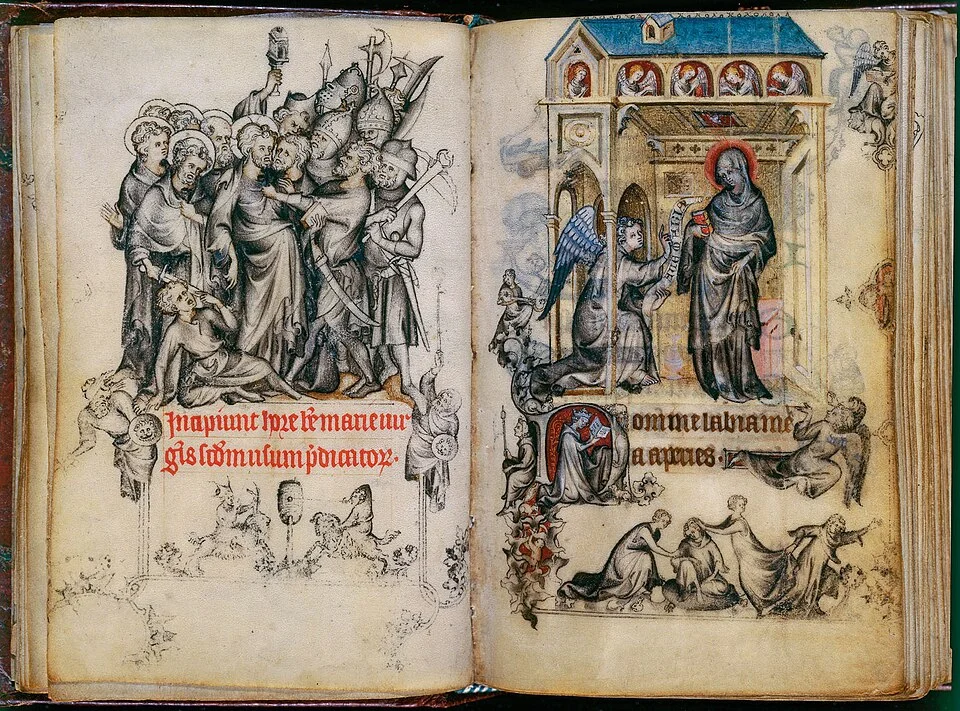
The book was almost certainly a gift from her husband. Books of hours were the standard royal wedding or coronation gift in 14th-century France, and the manuscript was made for a queen's private devotion: its text fits the palm, its prayers assume a single literate reader, and Pucelle placed a donor portrait of Jeanne herself into the Annunciation miniature — she kneels at her prayer desk on folio 16r, in the same scale and posture as the Angel Gabriel across the opening. 3 This is uncommon. Most royal patrons appear in a separate dedication page; here, Jeanne is painted directly into the moment of divine announcement, as if she is present when Gabriel tells Mary she will carry God's son.
Charles IV died on 1 February 1328, leaving Jeanne pregnant and seventeen. 2 She delivered a daughter, Blanche. No male heir meant the direct Capetian line — the unbroken dynasty that had ruled France for 340 years — ended in that delivery room. The crown passed to Charles's cousin Philip VI of Valois, launching the chain of succession disputes that would produce the Hundred Years' War nine years later. 3 Jeanne became a dowager queen at eighteen. She would live another 43 years, outlasting the king, the dynasty, the old world her book was made for.
She kept the book. When she died on 4 March 1371, at around sixty-one, her will transferred it directly to the next king, Charles V, with a description that would become the manuscript's earliest documentary fingerprint: "un bien petit livret d'oroisons que le roy Charles, dont Dieu l'ame, avoit faict faire pour Madame, que pucelle enlumina" — "a very small book of prayers that King Charles, God rest his soul, had made for Madame, which Pucelle illuminated." 3 Seven centuries later, that casual sentence in a will is still the primary evidence for the book's authorship and origin.
What Pucelle did that no one in France had done before
The miniatures look, at first glance, like drawing. There is almost no color — the figures are rendered in graduated gray tones, pen-drawn and gently washed, giving the effect of sculpture seen in diffuse northern light. The Met calls this effect "delicate grisaille," and notes it gives the figures "an amazingly sculptural quality." 1 Touches of lilac and turquoise appear in wings, roof tiles, and drapery lining — restrained accents that make the gray even grayer by comparison. Nothing else in France, in 1324, looked like this.
The technique had a name in contemporary inventories: "enluminées de blanc et noir" — illuminated in white and black. 3 What it did was replace the standard medieval palette — flat fields of blue and vermilion, hierarchically arranged against burnished gold — with something borrowed from the Italian south. Florens Deuchler, who served as chairman of Medieval Art at the Met and wrote the foundational 1971 study of Pucelle, stated plainly that this transformation "would not have been possible without the contribution of Italy — to be more specific, without the aid of Duccio." 4
Duccio di Buoninsegna's Maestà, completed for Siena Cathedral around 1311, was the model: its figures inhabit logically consistent rooms, cast shadows that fall in a single direction, and wear robes that drape as cloth actually drapes rather than as decorative pattern. 5 Giovanni Pisano's cathedral sculpture at Siena contributed equally — the physical pressure of Gothic stone figures, their bodies torqued in stress or grief, translating into Pucelle's pen-drawn men and women. Erwin Panofsky's verdict on what Pucelle achieved has not been substantially improved upon: the figures are modeled "by light and shade alone, suppressing all linear contours except for such details as facial features, hands and hair." 3 For the first time in northern manuscript painting, the human body had weight.
How Pucelle encountered Italian art is not fully known. He may have traveled south. He may have seen portable panel paintings or ivory carvings that crossed the Alps. The art historian Florens Deuchler, noting that "Pucelle" is an unusual surname for a Frenchman, speculated he may have arrived in Paris from Italy as a young man — possibly a Giovanni Pucelli — though no documentary evidence supports this. 4 What is certain is that his architecture has another source: Karen Gould's 1992 study identified direct compositional correspondences between the Hours of Jeanne d'Evreux and the sculptural program at Strasbourg Cathedral, particularly in the Passion cycle. 5 The book is a crossroads of Sienese painting, Gothic sculpture, and French court taste — all of it compressed into pages the size of a playing card.
Two cycles reading each other across an opening
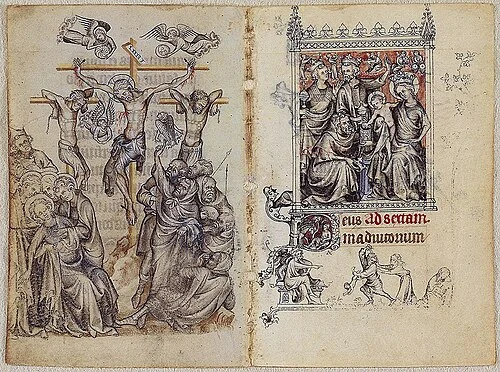
The book's structure is its most radical feature. Its 25 full-page miniatures are organized into three picture cycles, but the first two work in an arrangement no earlier manuscript had attempted: eight pairs of facing pages, each pair placing a Passion scene on the left (verso) and an Infancy scene on the right (recto). 3
The sequence runs:
The Arrest of Christ faces the Annunciation. Christ before Pilate faces the Visitation. The Flagellation faces the Nativity. Christ carrying the Cross faces the Annunciation to the Shepherds. The Crucifixion faces the Adoration of the Magi. The Deposition faces the Presentation in the Temple. The Entombment faces the Flight into Egypt. The Resurrection faces a lost miniature — probably the Coronation of the Virgin. 3
Each pairing is a theological argument. Jeffrey M. Hoffeld, writing in the same 1971 Met Bulletin issue, articulated it precisely: "The first two cycles of miniatures are historically related; our interpretation of the events of the Infancy is colored by our knowledge of the Passion. The artist makes the association of the two inescapable; the historical and the eschatological are juxtaposed. While the reader contemplates the moment of the Annunciation, his mind and his eye turn to the Arrest of Christ." 4
The visual echoes are deliberately planted. In the Nativity (folio 54r), the infant Christ lies in a manger that resembles a stone sarcophagus — the Entombment scene appears three pages to the left in the reader's memory. In the same miniature, the Christ child's legs are awkwardly crossed, a posture with no natural explanation for a newborn but an obvious one when you know the Crucifixion is facing you on the other side of the opening. 3 These are not accidents. A painter who could model three-dimensional figures in pen on a two-inch-tall page did not fail to notice how he positioned a baby.
The comparison most often made is with contemporary ivory diptychs — hinged portable altarpieces that likewise paired Passion and Infancy scenes on facing leaves. A queen familiar with such objects, opening her book each morning for the hour of Matins, would have recognized the structure immediately. 6 The book was itself a kind of folding altarpiece, small enough to close in one hand.
The third cycle, nine miniatures from the Life of Saint Louis, requires a separate explanation. Louis IX — king of France, crusader, canonized in 1297 — was Jeanne's great-grandfather. 2 A book of hours structured around the Hours of the Virgin would not normally include a separate saint's cycle at all, let alone one this length. But in the context of 1328 — the Capetian line just extinguished, Jeanne a young widow with a dynastic claim on the future — the choice to anchor her prayer life to the most sanctified Capetian king reads as something more than personal devotion. 3
The margins
The manuscript's 209 folios carry approximately 700 marginal illustrations. 1 Only ten pages have no decoration at all.
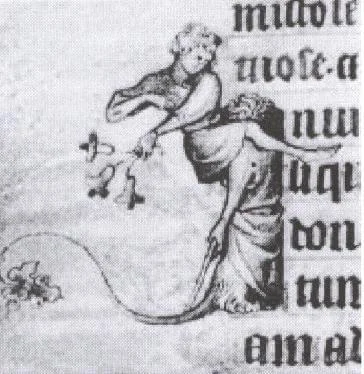
The margins contain bishops, beggars, street dancers, maidens, musicians with bagpipes, apes, rabbits, dogs, hybrid creatures with human heads and serpent tails, and at least one knight jousting while mounted on a large goat. 3 They populate the bas-de-page areas below the text, crawl up the vertical borders, hide inside historiated initials, and occasionally spill across the page as if aware there is no more room. They have been described, by the scholar who has written most carefully about them, as "some of the most intriguing and controversial marginalia of the entire Middle Ages." 7
The controversy is real. Lilian Randall's 1972 article in Speculum, "Games and the Passion," argued that the mock-joust scene at the opening of Matins — rendered, in her words, "with great verve and skill" — and the buffeting game that follows it are not merely decoration but symbolic commentary: the mocking of Christ at his Passion mirrored in the rough games of the street. 4 Michael Camille's Image on the Edge (1992) went further, reading the sexual and scatological registers of the marginalia as a structural inversion — the dirty world pressing against the sacred text, defining the sacred by contrast. 3
Neither reading is fully satisfying, which may be the point. Medieval manuscript margins were understood as spaces of licensed play — the illuminator's workshop releasing energy that the sacred page could not contain. The rabbits and apes and goat-jousters in Jeanne's book are street life, carnival, the noise of Paris bleeding through the vellum. A queen using this book for daily prayer would have been moving constantly between those two worlds: the silver-gray figures of Christ's suffering on the recto page, and, in the corner of the same page, a bagpiper with feet that end in leaves.
What the book contains, and its small mysteries
The manuscript opens with a calendar — twelve months of saints' days and feast days, each illustrated with a bas-de-page scene showing the labor of the month and the corresponding zodiac sign. 3 The Parisian saints are all here: Saint Cloud, Saint Germain, the local calendar of a city rather than a generic liturgical template. Then the main body: the Hours of the Virgin, structured around the eight canonical hours from Matins to Compline, with the eight paired Passion/Infancy miniatures distributed at the major divisions. After that, the Penitential Psalms, a Litany, and the Hours of Saint Louis with its nine devotional miniatures. The book closes with an image of Christ Enthroned, surrounded by the symbols of the four Evangelists (folio 182v). 3
The text uses Dominican rite — the form of the canonical hours as said by the Order of Preachers — while the calendar and litany are unmistakably Parisian. Elizabeth Flinn, in her 1971 Met Bulletin article, noted that this combination suggests "two different models were accidentally used." 4 The Wikipedia article on the manuscript, citing the Codices Illuminati facsimile edition, proposes it was deliberate: Jeanne had close ties to the Dominicans and may have specifically requested their rite. 3 The calendar's more than thirty misspelled saints' names and fifteen incorrect feast dates — corrected nowhere in the book — are harder to explain either way. They suggest, at minimum, that the scribe who copied the text was working from a model he could not fully read, and that the book was either finished in haste or never quite completed. Ten folios with no decoration at all point in the same direction: a manuscript left slightly unfinished, probably because the client needed it and could not wait. 3
The question of who made it
Jean Pucelle is the artist by near-universal agreement — but the agreement is more complicated than it looks. Florens Deuchler's 1971 Met Bulletin article, titled with deliberate provocation "Jean Pucelle — Facts and Fictions," laid out the problem: "We call him Jean Pucelle, although we do not know who he was, whether he worked as a chef d'atelier — the master of a workshop — or whether he was just an enlumineur we hear of by chance more often than we hear of his many colleagues working in Paris." 4
The name appears in a 1327 Paris tax roll, in a few colophons, and in Jeanne's will — that is essentially the documentary record. What survives of his work — the Belleville Breviary (Bibliothèque nationale de France), the Robert de Billyng Bible, possibly the Blanche of France Franciscan Hours — shows multiple hands in a "Pucelle style," not necessarily Pucelle's own hand. The Hours of Jeanne d'Evreux is the exception: Kathleen Morand and Karen Gould both maintain it is the only manuscript one can be confident "was entirely executed by the hand of Pucelle." 3 The consistency of the grisaille modeling across all 25 miniatures, and the internal coherence of the visual program, support this. Whatever "Pucelle" means — workshop master, individual artist, label for a collaborative style — the intelligence behind this specific book was singular.
Six centuries on the move: the provenance chain
From Charles V, the book passed to Charles VI, and then into the library of Jean, Duke of Berry — Charles V's brother, and by 1400 the greatest book collector in Europe. 3 Berry's 1401 inventory describes it with precise pleasure: "Item une petites heures de Nostre Dame, nommée Heures de Pucelle, enlumées de blanc et de noir, à la usaige des Prescheurs" — a small Hours of Our Lady, named the Hours of Pucelle, illuminated in white and black, in Dominican use. 3 By the time Berry catalogued it, the pearl-studded cover Jeanne had likely used was gone, replaced with blue silk. 3 Berry also owned the Belles Heures and the Très Riches Heures, two of the most celebrated manuscripts ever made; among those, he kept the tiny book a dead queen had carried for forty-three years.
Berry died in 1416. After that, the manuscript disappears from the record for roughly two hundred years. 3 Where it went during the upheavals of the Hundred Years' War, the regency crises, and the French civil wars of the 15th century is unknown. It surfaces again around 1618, when a new leather binding was made bearing the coats of arms of Louis-Jules de Châtelet (1594–1671) and his wife Christine de Gleseneuve Bar — a French noble couple whose library has not otherwise been studied. 1 Châtelet died around 1671; the book then vanishes again for another two centuries.
In the 19th century it reappears in Switzerland, in the possession of Adolphe Carl Rothschild at the Pregny château outside Geneva. 8 His widow held it until 1907; it then passed to his nephew, Maurice Edmond Charles Rothschild, in Paris. 3 Maurice was still in possession of the book when German troops entered Paris in June 1940.
The wastepaper basket at Neuschwanstein
In January 1941, Nazi agents working for the Einsatzstab Reichsleiter Rosenberg (ERR) — the systematic looting apparatus that stripped Jewish-owned collections across occupied Europe — confiscated the Hours of Jeanne d'Evreux from Maurice de Rothschild's Paris holdings. 3 It was assigned the inventory number R.1052 and transported to Neuschwanstein Castle in Bavaria, one of the ERR's primary storage depots for looted art from French collections. 9
Neuschwanstein by 1944 held thousands of objects: paintings, sculptures, tapestries, furniture, silver, books. Allied forces reached the castle in the spring of 1945. When recovery teams searched the rooms, they found the Hours of Jeanne d'Evreux — a 700-year-old manuscript that had survived the Black Death, the Hundred Years' War, two revolutions, and the dissolution of every dynasty that had ever owned it — hidden inside a wastepaper basket. 9 Someone, presumably during the chaos of the German retreat, had put it there in hopes it might escape detection. The manuscript was undamaged.
It was formally restituted to Maurice de Rothschild in 1948. 3
The Saint Louis who ministered to the sick
The final section of the manuscript — the Hours of Saint Louis — deserves a moment of close attention, because its images are among the most moving in the book.
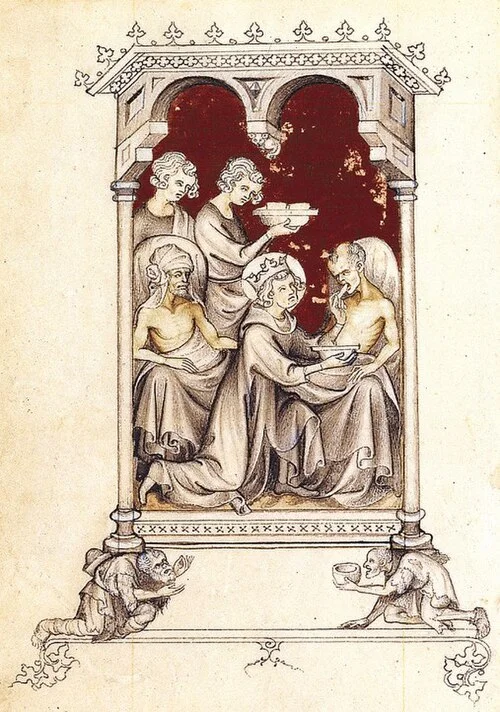
Nine scenes depict moments from Louis IX's life, drawn from Guillaume de Saint-Pathus's biography of the king: his education, his acts of charity, his care for the sick, his crusade. 3 In folio 142v, Louis kneels beside a bed, his crowned head bowed, his hand on a plague victim — a gesture of physical, unglamorous mercy that Pucelle renders with visible specificity: the patient's skeletal arms, the creases of illness in the face, the crown as incongruous as a party hat in a hospital ward. The scene was based on documented events from Louis's reign; he was famous for personally nursing lepers and the dying, the same king who built the Sainte-Chapelle and twice led crusades. Jeanne's great-grandfather. Canonized 27 years before this book was made.
For a widowed queen navigating the political wreckage of a dynasty she had not been able to save, the presence of Saint Louis in her daily prayers was not incidental.
Rockefeller, The Cloisters, and the final acquisition
Six years after the restitution, Maurice de Rothschild sold the manuscript through the New York art dealers Rosenberg and Stiebel, Inc. The buyer was The Metropolitan Museum of Art; the donor was John D. Rockefeller Jr. 10 The manuscript entered The Cloisters Collection in 1954 as accession 54.1.2. 1
The Cloisters itself was a Rockefeller creation. He had purchased George Grey Barnard's collection of medieval architectural fragments and sculpture for approximately $700,000 in 1925, donated the Fort Tryon Park site, and funded the construction of the museum building — an exercise in academic reconstruction that opened on 10 May 1938 in upper Manhattan, with views across the Hudson toward the Palisades that Rockefeller had also bought to preserve the sight line. 10 The institution already held the Unicorn Tapestries, the Belles Heures of Jean de Berry, and the Cloisters Apocalypse. The Hours of Jeanne d'Evreux, arriving sixteen years after the opening, brought the manuscript collection its defining piece.
The purchase price Rockefeller paid through Rosenberg and Stiebel has not been disclosed in any public record. 8
The book today
The Hours of Jeanne d'Evreux is currently on permanent display in Gallery 13 at The Met Cloisters, Fort Tryon Park, New York. 1 It lies open under filtered museum light, showing two pages from its 700-year interior.
The Met has digitized the entire manuscript and made it freely available through its Open Access initiative, with approximately 150 high-resolution images accessible through the IIIF API. 1 On a screen, enlarged to twelve inches across, the figures look like frescoes — the spatial depth Pucelle borrowed from Duccio becomes visible in a way it cannot be at actual size. Then you remember that the original is narrower than your phone. The figures were painted at a scale where the full body of Gabriel, standing inside a convincingly receding Gothic chapel, is about three-quarters of an inch tall.
Kathleen Morand's assessment still frames the manuscript's place in the history of art: it represents "the high point of Parisian court painting" and "the unprecedentedly refined artistic tastes of the time." 3 Deuchler's complementary observation gives that assessment its full context: "For the first time in the North, the figures are no longer arranged flatly on small stages but are placed in a coherent perspective setting." 4 What Pucelle set in motion in Paris around 1324 — the integration of Italian spatial modeling into northern Gothic illumination — would eventually, through a long chain of influence, reach the Flemish painters of the 15th century, who in turn transmitted it to the entire subsequent tradition of European painting. The branch point is this book. The branch point is three and a half inches wide.
In the wastepaper basket at Neuschwanstein, it survived. Someone who knew what it was put it there, hoping. They were right.
Cover image: The Hours of Jeanne d'Evreux (fols. 15v–16r): Arrest of Christ and Annunciation, ca. 1324–28. Jean Pucelle. Grisaille, tempera, and ink on vellum. The Metropolitan Museum of Art, The Cloisters Collection, 1954 (54.1.2). Public domain, CC0.
Fuentes de referencia
- 1The Metropolitan Museum of Art: The Hours of Jeanne d'Evreux
- 2Wikipedia: Joan of Évreux
- 3Wikipedia: Hours of Jeanne d'Evreux
- 4The Metropolitan Museum of Art Bulletin, v. 29, no. 6 (February 1971)
- 5Wikipedia: Jean Pucelle
- 6Wikipedia: Book of hours
- 7A Scholarly Skater: The Hours of Jeanne d'Evreux – Day 2
- 8Getty Research Institute: CONA Full Record
- 9Facsimile Finder: Hours of Jeanne d'Evreux Facsimile Edition
- 10The Cloisters – Wikipedia
Añade más opiniones o contexto en torno a este contenido.